I hate to admit it but this book took a while for me to write. There was so much going on in the world and in my head that I kept tripping over stumbling blocks. Well, that is behind me now and looking forward to the future. I can’t believe there is better timing for the release of this title. This book deliberately takes an apolitical approach, while fostering civic engagement and participatory citizenship. I’m looking forward to feedback from my fellow colleagues, so please share either here, on Amazon, or elsewhere.
Today, February 4 is the anniversary of Rosa Parks‘ birthday. Famous for her role in the Montgomery Bus Boycott, Rosa leaves us with an enduring legacy of resistance against racial discrimination and injustice.
People always say that I didn’t give up my seat because I was tired, but that isn’t true. I was not tired physically, or no more tired than I usually was at the end of a working day. I was not old, although some people have an image of me as being old then. I was forty-two. No, the only tired I was, was tired of giving in.
Beyond the Bus Boycott: Rosa Parks’ Activism Before and After 1954 is a lesson to foster lifelong activism. Take a look here.
With Thanksgiving coming up, I wanted to take a moment to wish you a Happy Thanksgiving.
As we celebrate, it’s also important to remember the history of this holiday and its impact on Indigenous peoples. A great way to do this is by learning about the Indigenous tribes that originally lived in areas where you live and work. You can use the Native Land website and app to look up an address and find out which tribes were there historically or currently reside in the area.
The Islip UFSD area, where I work, was originally populated by the Secatogue; hence the name of our yearbook. I currently live on land inhabited by the Massapequas but will be traveling to Susquehannock land to visit with my family.
Typically, when I write about my travels it usually involves a visit to a local library or bookstore. I’m going to break tradition and discuss my trip to Munich, Germany this summer. More specifically my visit to Dachau, a former Nazi concentration camp and now memorial site honoring the lives lost, honoring the suffering endured by survivors, and continuing education so others may learn to prevent such tragedies.
I planned typical tourist attractions such as visiting castles (Neuschwanstein), churches (Frauenkirche), and historical sites such as the Beer Museum and Marienplatz. I even crossed off a bucket list item, visiting the surfers at the Eisbachwelle. I signed up for several tours, but not the Third Reich Walking Tour. I figured Munich is full of history and many stories and anecdotes would find their place on other walking tours – and they did.
As part of the Beer Tour, we visited the Hofbräuhaus. In February 1920, Hitler gave a speech outlining the manifesto or political philosophy of the Nazi Party. “The Hofbräuhaus is also where Hitler publicly denounced the Jewish people and gave the infamous “Why We are Antisemites” speech.” Another walking tour took us to Viscardigasse, an alley with bronze cobblestones that serves as a memorial to those who resisted Nazi tyranny. And most of the tours I took began just a block or two from the House of Justice where members of the White Rose movement were sentenced.
With so much ongoing vitriol and rhetoric experienced daily in the US, I felt it was imperative that I visit the Dachau memorial site.
Our tour group arrived at Dachau after a short, one stop train ride from Munich Hauptbahnhof. We then boarded a public bus that took us from the Dachau train station to the entrance of the memorial site; former inmates were required to walk this distance.
I knew I wasn’t jiving with our guide before we arrived. She appeared unconcerned with members of our group who had physical difficulties (boot, cane). ‘If I lose you, it’s only one stop, just get off the train.’ And the solo traveler, teacher, and mom in me didn’t appreciate the ‘Is everyone here? Tell me if someone from your group is missing.’ What??? I’m a solo traveler, no one is going to miss me. Seriously, just count heads. As with many tour companies in Munich, the guides now living in Germany hail from all over – ours was from Spain.
Well, when we entered the site and she began her spiel the hairs on my body rose immediately, a sense of dread enveloped me and not just because we were in a hallowed location steeped in death and degradation. Our guide accurately described Dachau as a work camp, not an extermination camp whose purpose was solely the extermination of human lives. So, this camp “wasn’t so bad.” Just in case we were confused or thought we might have heard her incorrectly she repeated this phrase numerous times. It ‘wasn’t so bad.”
Yes, perhaps it was ‘better’ than being murdered straight off the train. However, no human being should ever be forced to brutality experience life like this. It’s called war crimes for a reason.
We arrived at the crematorium – which was needed because of the numerous deaths due to hunger, exhaustion, and disease, the direct result of being tortured, or were brutally murdered in the Dachau concentration camp. Work did not set everyone free. According to the US Holocaust Memorial Museum, “Scholars believe that at least 40,000 prisoners died there.”
Next to the crematorium was a gas chamber shower area. Though, according to our guide, it was never used. The guide again thought this was a good thing. Yes, it’s here but it wasn’t used. Excuse me but the intention was there. Why build it otherwise? It’s not likely to get a spread in Architectural Digest magazine. No. It was installed for a purpose. It was designed for killing. This was the mindset of the people running the camp and the country. According to the Dachau Memorial website, “Killing people on a mass scale through poison gas never took place in the Dachau concentration camp. It remains unexplained as to why the SS never used the operational gas chamber for this purpose. According to one contemporary witness account, some prisoners were killed by poison gas in 1944.” but also says the following just a paragraph away on the same page, “In the spring of 1942, work began on building “barrack X”, which was then put into operation a year later. This was a crematorium with four furnaces, a disinfection chamber for clothing, dayrooms and sanitary facilities, as well as morgues and a gas chamber disguised as a “shower bath”. There can be no doubt that “barrack X” was designed for the mass extermination of prisoners.” This seems contradictory. Regardless, no one needs to build a gas chamber. Period.
This was our last stop together at the camp before we went off to explore on our own. I was grateful to get away from our tour leader and wondered why I didn’t ditch the group sooner. I guess I was too shocked and surprised by the experience. Do you ever feel that way? This experience has made me more self-aware that I need to do more when I encounter situations like this. Let’s just say, by the time we got back to Munich our guide didn’t like me much. I had numerous conversations with my fellow group participants relaying my concerns over choice of words used and the general depictions used. Many of us were listening in on the other tours going on rather than our own.
This less than concerned, lackadaisical approach to history left me feeling exhausted and scared for our global future. History repeats itself if we don’t take it seriously and if we fail to heed the warning signs. In the last fifteen minutes of my morning spent at Dachau, I left feeling a bit more hopeful. That’s because on the way out I passed a small group quietly praying and subsequently broke out in quiet song. Hatikvah (The Hope), was their song of choice. Hearing those words was the balm I needed to soothe my soul.
For the past two years our library has celebrated Squirrel Appreciation Day. Yes, there is such a national celebration every year on January 21. We have highlighted the occasion by handing out informative squirrel bookmarks, which are always a hit.
This year we decided to kick things up a notch. That’s right – a READ TO A SQUIRREL event with the goal of promoting reading.
In addition to the bookmarks, this year we added squirrel stickers which were a hit.
To enhance efforts to increase reading for pleasure, this day long Read to a Squirrel Event was offered to students on a Friday.
Students who sat in our back area (Fiction Section) with a book to read were offered hot cocoa and a plush squirrel they could read to or just cuddle while reading.
Morning announcements and signs created a buzz in advance of the activity. Students were quite excited. More surprisingly was that staff members were equally excited.
Teachers reading to squirrels!
We had a surprise visit with Fredo and Enzo, Chilean ground squirrels. Thanks to a science teacher, Fredo and Enzo got to spend the day in the library.
Overall the day was successful – students read, staff read, all associated reading as a fun experience. Based on the feedback received we’re wondering who we should read to next!
Our library makerspace is consistently used during the holiday season. Lots of card making and crafting personalized gifts keep our students busy. This year we added a fun challenge. Create an ugly sweater. Many students took us up on this challenge and goodness the results were quite… well, ugly.
We left a template of a sweater in the makerspace area and the students could use any materials they could find to create their own masterpiece. The activity quickly gained attention as students displayed their work in the library.
Template
The judging was done by student popular vote and there were secondary ribbons for various categories judged by the library staff. All in all, we had lots of fun and we got to experience a fun, festive, and creative side to our students.
Not my typical library blog post, but something that helped me get through a rough school year….
hygge (noun): the feeling of coziness and contentment evoked by simple comforts
Why do I find soup to be the epitome of hygge? Oh, let me count the ways….
Nothing beats the feeling of a warm bowl of soup on a winter’s day.
Soups are traditionally simple. Yet within this simplicity soups are packed with so many healthy nutrients strengthening our bodies and mental wellness, too.
In preparing soup one must peel and chop vegetables requiring considerable concentration. During this focused time, we get to slow down and clear our minds.
Aromatherapy. Once all our ingredients are assembled and cooking, the smell of bay leaves, thyme, or peppercorn elicits our human experience, grounding and soothing us. More on aromatherapy click here.
Through soup we experience all our senses. The aromatic smell. The delicious taste. The feeling of warmth as we cradle our bowl of sustenance. The soups of neutral or vibrant colors show us nature’s bounty. Hearing the slow simmer as our soup boils to perfection is nature’s music. As you can see, I am passionate about soup.
However, with fewer family members living at home, I cook less. That’s why a group of us at work decided to implement a ‘soup exchange’ for the month of February. It’s kind of like a cookie swap but with soup. Each week I know I will enjoy several varieties of soup. This week was butternut squash, chicken soup with rice, Italian gnocchi soup, and pea soup. Yum. I’m looking forward to next week and subsequent weeks to see what I’ll experience both in giving and receiving.
I highly recommend finding a few likeminded friends or colleagues to start your own soup exchange.
Okay, so this is not my typical topic for a blog post. However, let me explain why I’ve chosen to write about it. I’ve been feeling overwhelmed this school year. It’s not a typical year; it’s a year filled with many changes and stressors. I know it’s the same for my students and I want to help them. But how do I do that when I’m not at optimal mental wellness? It’s difficult to help others when you can just about take care of yourself. So, this year I’ve dedicated myself to finding new ways of boosting social emotional wellness through natural ways. Let’s just say, so far stress eating hasn’t worked out so well 😉
As part of an activity for our Staff Hygge Group, I arranged a certified forest therapy guide to take us out to explore and experience nature. We have off for President’s Week and due to the pandemic few, if any of us are travelling, so this was a perfect week. Though cold with snow and ice on the ground, we managed to set out on a sunny day. First, let me make it clear that COVID precautions were in place. Even though, we spent over two hours outdoors – masks were worn and social distancing (except for a group photo op) was maintained.
Cold, but content
During our time communing with nature, we were ‘invited’ to experience the forest in unique ways. A series of seven invitations encouraged us to examine, smell, see and create. Let me be clear this was not a hike. We covered a mile in two hours. This was a mindful path through nature where we took time to experience nature, not to walk past it to get from point A to point B or to count towards 10,000 steps. This was an opportunity to slow down. To breathe. To see, really see. And, to embrace a mindful experience.
An invitation to create
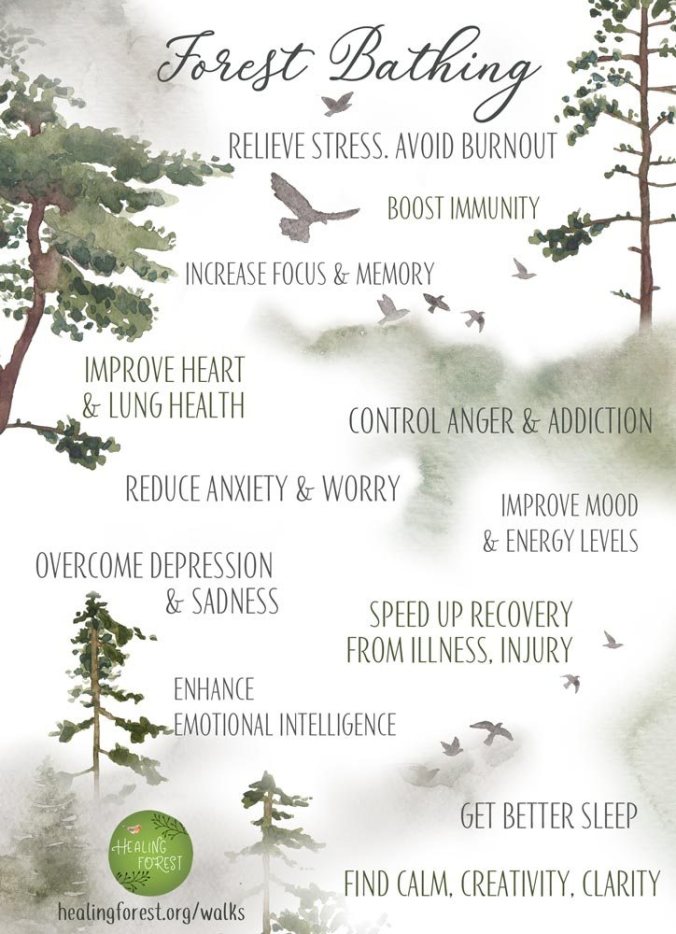
What are the benefits? Plenty.
Needless to say we are already planning our next forest bathing excursion – a little closer to Spring. The cleansing and healing powers of the forest have revived me. And so, I look forward to continuing to find my home amongst the trees.
May the forest be the place where your heart finds its home. Namaste.
Last week I facilitated a Crafting your Grief session for the Islip Public Library. I, like most widows, find the holidays a bit of a challenge. During this session I provided the craft supplies and some resources. Today I’d like to share some of those resources to you, my readers.
Tonight begins Hanukkah, the Festival of Lights. There’s beauty and a sense of peace one feels while gazing into the warm glow of firelight. As I write this I reflect on a new family tradition borne out of necessity.
4 votive candles on a festive plate
Two years ago on Thanksgiving, our family started a new holiday tradition – lighting four candles in memory of my husband. It was our first holiday without him and the first time in thirty years we celebrated elsewhere. We were already experiencing changes in our lives and celebrations but I wanted to take back some small sense of control by initiating a new family tradition of our choice.
That’s when the Four Candles tradition began. It’s not easy finding a candle holder with four branches. One, two, and three stems seem most common. I didn’t like any of the commercial candleholders I found. So I decided if you can’t find one you like, make your own!
You will need
4 votive candles
Label maker (or decorative markers)
1 5 x 7 piece of stiff cardboard
Wrapping paper (could also use aluminum foil)
Ribbon or decorative bling, optional
Glue gun
tape
Scissors
Instructions
Wrap the cardboard with paper or foil and tape
Glue the votive candles to the wrapped board
Glue the ribbon and any decorations to the board
Using a label maker (or sharpie markers) write out thes four words: grief, love, And attach to the votive holder
Alternatives: Use LED battery operated votive candles if you don’t wish an open flame. Upcycled Oui yogurt jars can be used as a candle holder, for a more permanent candle display. Pick and choose colors you like and that have meaning for you and your loved one.
When former family traditions no longer fit, it’s okay to create new ones.